
Corporate lobbies & conference rooms
LED video walls for reception areas, boardrooms, town-hall spaces and briefing centers — specified for the people in the room and for the cameras on every call.
A seamless LED wall does what a grid of flat panels can't: one picture with no bezels through it, built to the exact size and shape of the wall, bright enough for a sunlit atrium. And in a building where every meeting is a video call, it has to look as good on camera as it does in person.
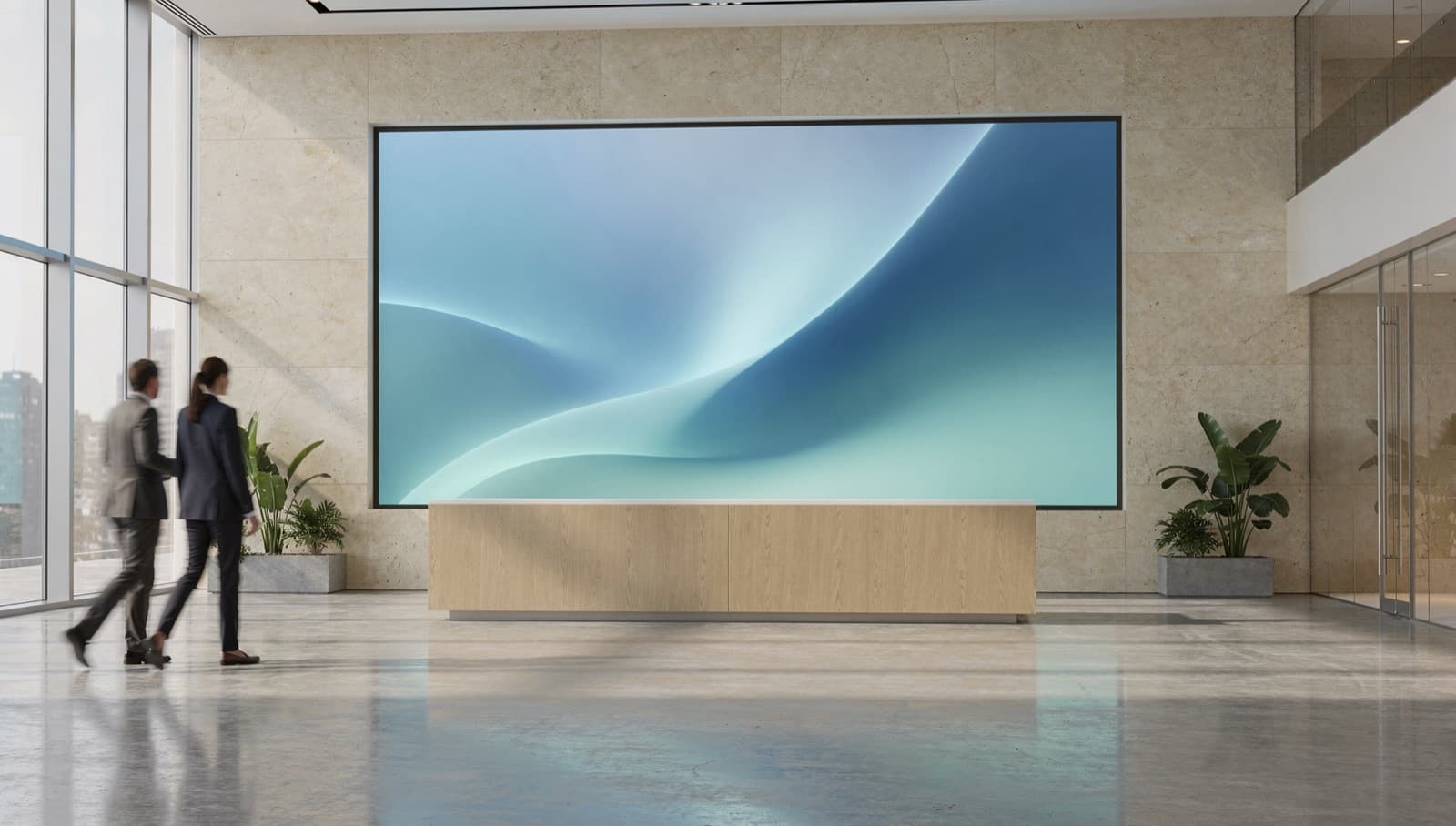
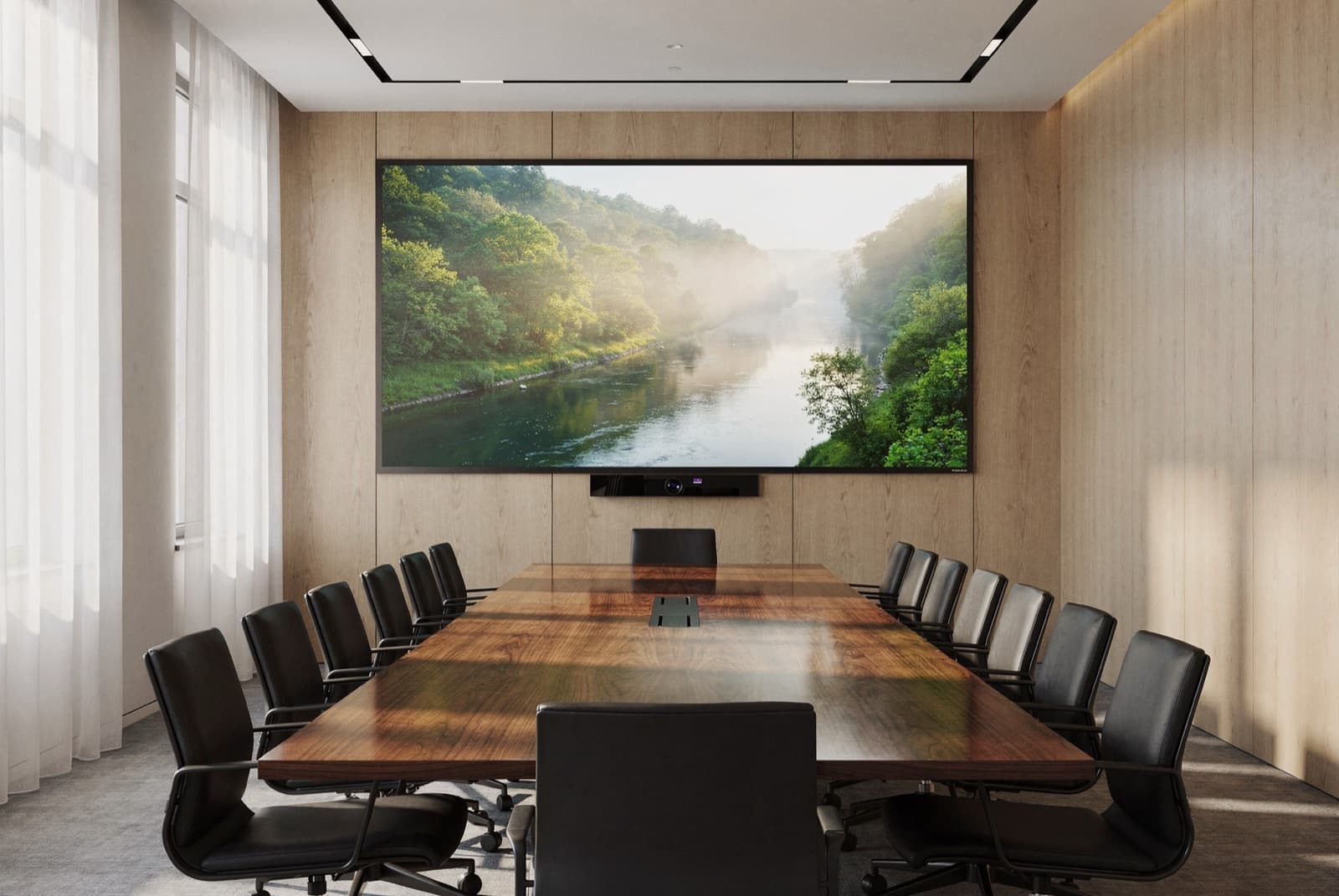
Where it goes
From the wall visitors see first to the rooms where the work gets done.
Reception & lobby walls
The first thing a visitor sees, and the one display people walk right up to. Seamless LED built to the exact architecture — across a feature wall, around a column, over a reception desk — running brand content, welcome messages and live data.
Boardrooms & conference rooms
The wall that replaces the pair of large TVs with a line down the middle. One seamless picture big enough for the far end of the table, with the video call, the deck and the spreadsheet on screen at once.
Town halls & all-hands
A backdrop for the CEO in the room and on the stream at the same time. Big enough for the back row, and specified so it doesn't flicker, band or blow out the exposure on the broadcast camera.
Executive briefing centers
Rooms built to close deals and host partners, where the display is part of the story. Curved, wrapped or immersive LED with content that changes for every visit.
Training & multipurpose rooms
Spaces that host a workshop in the morning and a client event after lunch. LED that can split into several sources for sessions and go back to one picture for presentations.
Operations & data walls
Dashboards, maps and monitoring feeds that people read from across the room all day. Fine pitch so small text stays legible, with a layout the processor can rearrange as the work changes.
Every meeting room is a camera set now
Most display installers design for the people in the room. We come from virtual production, where LED is judged through a lens — and in a hybrid office, the lens is where half your audience is sitting.
The wall is in the shot all day
Every hybrid meeting points a camera at the room, and the wall is usually in frame. LED that looks fine to the eye can roll, band or flicker on a webcam. We specify refresh rate and set up the processor so remote attendees see a steady picture, not a strobing one.
Town halls are a broadcast
The moment an executive stands in front of the lobby wall and the stream goes live, that wall is a set. Refresh, scan rate, color and brightness against the presenter's face are film-set problems — the ones we solve on LED stages.
Brightness that doesn't backlight people
A wall at full brightness behind a presenter turns them into a silhouette on camera. We calibrate brightness for the room and the content, not to the number on the spec sheet.
Checked through your cameras
Moiré depends on the pitch, the lens and the distance between them, so it can't be ruled out on paper. We check the wall through the room's actual cameras before handing it over.
Choosing the pitch for the room
Pixel pitch — the spacing between LEDs — sets both how close someone can stand before the pixel grid shows and most of the price. Finer than the room needs is money spent where nobody can see it; coarser, and the front row reads a screen door.
The rule of thumb is 8 feet of viewing distance per millimetre of pitch, measured from the closest person who regularly looks at it.
When a flat panel is the better buy
Under about 100 inches, a good commercial flat panel usually costs less and does the job. LED earns its price above that size, where a grid of flat panels would put bezels through faces and spreadsheets — and anywhere the wall isn't a rectangle, faces the sun, or has to run all day for years. We'll tell you which side of that line your room is on.
Starting points by room
| Room | Closest viewer | Pitch |
|---|---|---|
| Huddle & conference rooms | 6–8 ft | P0.78–P0.95 |
| Boardrooms | 8–12 ft | P0.95–P1.5 |
| Operations & data walls | 8–12 ft | P0.95–P1.5 |
| Reception & lobbies | Walk-up | P1.2–P1.9 |
| Town halls & all-hands | 20 ft + | P2.5–P3.9 |
From the 8 ft/mm rule. Lobbies land finer than their size suggests because people walk right up to them. The LED Wall Builder works out resolution, power and weight for a specific wall.
What IT and facilities need to know
A display wall lives in the building for a decade. These are the questions that decide whether it's easy to live with.
Fits the room you already run
The wall takes its signal from the room system you have — a Teams Rooms or Zoom Rooms PC, a switcher, a media player — and takes commands from your Crestron or Q-SYS control, so the meeting still starts from the same touch panel.
All-in-one or built to size
For standard boardroom sizes, an all-in-one LED display arrives as a single unit with its controller built in. For anything custom — a feature wall, a curve, an odd architectural opening — we build it from modules to the exact size.
Content that runs itself
Lobby walls need content on a schedule, not someone remembering to press play. We build the signal path from your media player or signage platform to the wall so marketing can update it without a service call.
Serviceable without closing the room
Front-service cabinets mean a failed module is swapped from the front in minutes, and spares ordered from the same production batch mean the replacement matches the panels around it.
Power and heat in the spec
A large wall can draw kilowatts at full white and put that heat into a small room. Circuits and the HVAC load are planned up front with your facilities team, not discovered on move-in day.
Panels you can source again
We install Unilumin, ROE Visual, Aoto and Planar panels driven by Brompton, Novastar or Megapixel VR processing — established manufacturers, so extending the wall or adding a matching room later is straightforward.
In-house studios & brand experiences
If the plan is to produce video in-house — a content studio, a product-launch stage, an immersive experience center — that's a virtual production build, and it has its own page.
Planning a lobby or boardroom?
Send us the wall dimensions, the room and how it's used. We'll come back with a pitch, a size and an honest answer on whether LED is the right call.