
Home theater & residential LED
Direct-view LED walls for home theaters, media rooms and outdoor living — sized to the room, specified for the seats, and installed by the team that builds LED stages for film.
An LED wall is the screen with no ceiling on size: no bezels, no lamp, bright enough to watch with the lights on, and built from modules so it fits the wall you have instead of the nearest size a television comes in. It is also the easiest screen to get wrong, which is where we come in.
Where it goes
Every room asks something different of the wall — darkness, daylight, weather, or a camera.
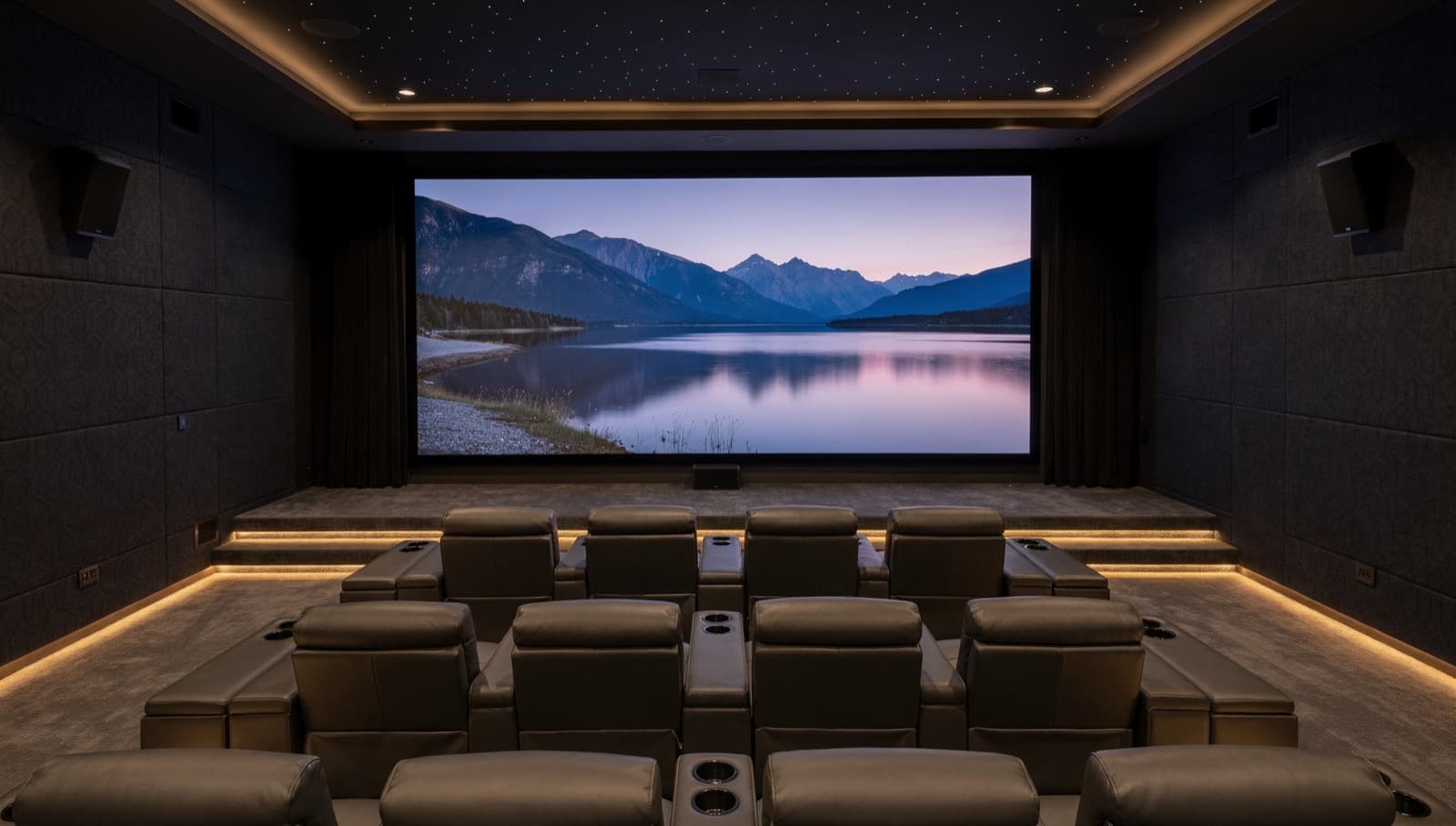
Dedicated home theaters
Lights-off cinema at a size no television ships in. Direct-view LED has no lamp to fade and no screen to wash out, deep blacks with the lights down, and the headroom for HDR highlights that a projector can only approximate.
Media & family rooms
The room people actually watch in has windows. LED holds its picture with the lights on and the blinds open, which is where projection gives up — so the big picture stops being an evening-only event.
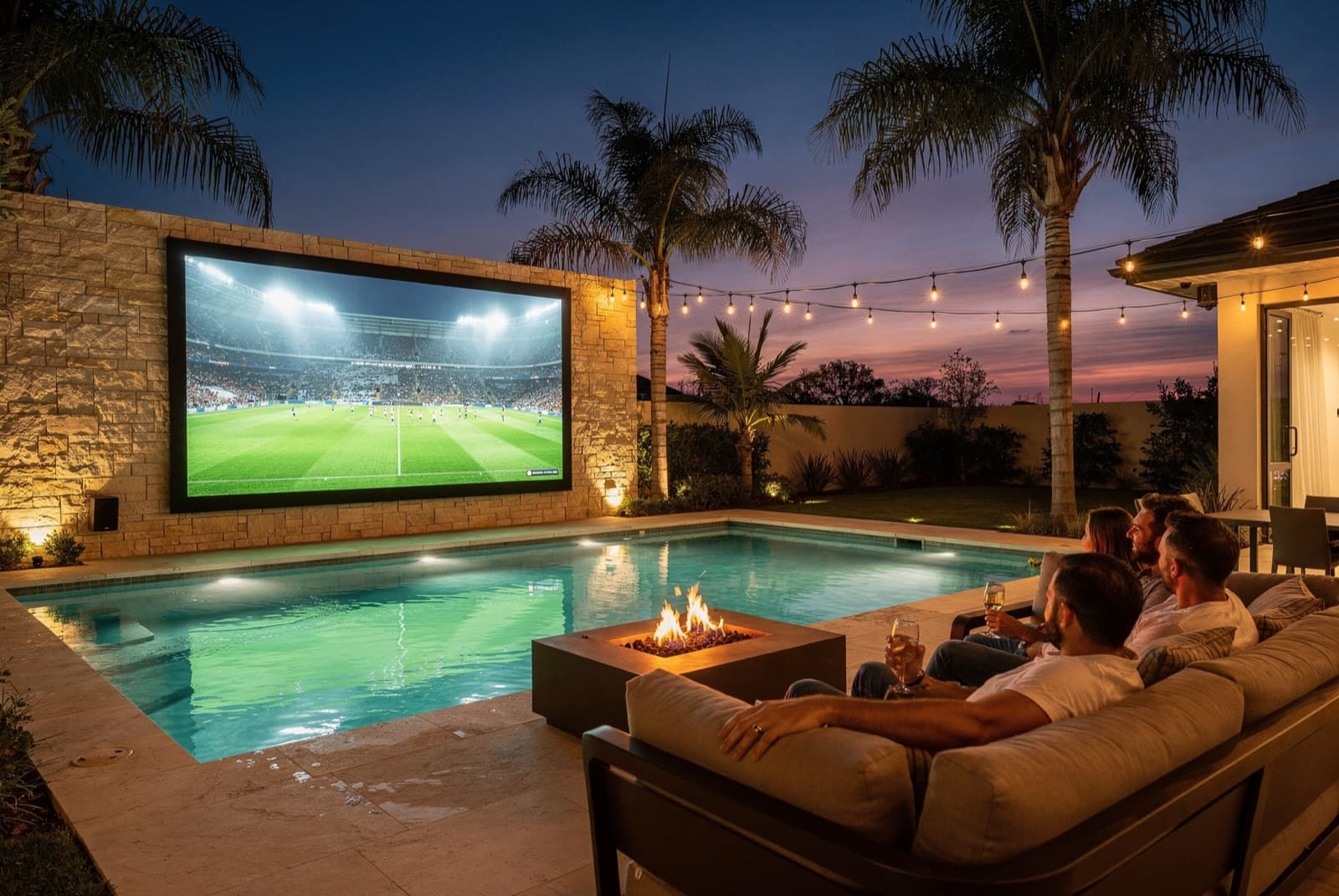
Outdoor living & pool areas
Weather-sealed LED bright enough for an afternoon in direct sun, dimming itself at night so the game is watchable and the neighbors are not lit up. Mounted on a structure rated for your wind, not bolted to a pergola and hoped for.
Game rooms & sports viewing
One seamless wall that can split into several feeds at once on game day, then go back to a single picture for a film. The processor handles the windows, so there is no bank of TVs and no bezels through the middle of the pitch.
Home studios & content rooms
A backdrop for streaming, podcasts and creator work — the same thing we build for production studios, scaled to a room. Specified to look right through a camera, because that is the only way anyone else will see it.
Art walls & architecture
LED built into the architecture rather than hung on it: flush in a niche, around a corner, or across a wall no rectangle would fit. Off, it reads as a finished black surface; on, it is whatever the room needs.
What “4K” costs on an LED wall
An LED wall's resolution isn't a model number — it's the pixel pitch, the distance between LEDs, multiplied across the width of the wall. Native 4K is 3,840 pixels across, so the bigger the wall, the finer the pitch has to be. That pitch is what drives the price.
The other half is where you sit. A common rule is 8 feet of viewing distance per millimetre of pitch: closer than that and the pixel grid starts to show. From 12–13 feet back, a P1.5 wall's grid disappears entirely.
So the real question is the trade between detail and budget, and it's specific to your seats. We'll show you both options side by side rather than defaulting to the most expensive one.
Native 4K, 16:9
| Screen size | Pitch needed | Closest seat |
|---|---|---|
| 110" | P0.63 | 5 ft |
| 136" | P0.78 | 6 ft |
| 146" | P0.84 | 7 ft |
| 165" | P0.95 | 8 ft |
| 200" | P1.15 | 9 ft |
| 220" | P1.27 | 10 ft |
Pitch from 3,840 pixels across the 16:9 width. Closest seat from the 8 ft/mm rule, rounded. Any size in between works — the LED Wall Builder will work it out for your wall and your panels.
What a home asks that a stage doesn't
We build LED that gets pointed at cinema cameras, so the picture standards are the easy part. A home adds its own list — and these are the things that decide whether you love the wall in a year.
It has to be silent
A lot of LED built for stages and stadiums is fan-cooled, and in a treated theater you will hear every one of them in the quiet scenes. We specify fanless cabinets for rooms where silence matters and move the processing and power supplies out of the room.
Speakers can't go behind it
A projection screen can be acoustically transparent; an LED wall can't. The center channel and front speakers have to go around it — above, below, beside, or phantom — and that decision belongs at the start of the design, not after the wall is up.
The processor matters as much as the panels
Between your AV receiver and the wall sits an LED processor, and that is where scaling, HDR tone mapping and color are decided. We use Brompton, Novastar and Megapixel VR processing — the same hardware that drives LED on film sets — and set it up for your sources.
Heat and power are planned, not discovered
A large wall at full white can draw kilowatts and put that heat into the room. Dedicated circuits, ventilation and the HVAC load are part of our spec, so the first bright movie doesn't trip a breaker or warm the room.
Calibrated in the room it lives in
Panels are calibrated for uniformity across every seam and for color in your room's light, then checked from the seats. A wall that looks perfect in a showroom can look patchy at home if nobody does this part.
Built to be serviced
Front-service cabinets let a wall sit flush in a niche and still have a single module swapped in minutes. Spare modules are ordered from the same production batch as the wall, so a replacement matches the panels around it.
Outdoor screens
Outdoors, the sun sets the spec. A screen that faces open sky needs several times the brightness of anything indoors, a cabinet sealed against rain and dust, and a structure that answers to the wind.
- 5,000 nits and up for direct sun — more for a south-facing wall with no shade
- IP65-sealed cabinets rated for your summers and winters
- Automatic dimming at dusk, so evenings are comfortable and the neighbors stay dark
- Coarser pitch than indoors is fine — backyard seats are usually 15–30 feet back
- Wind-rated mounting and structure, with permits and HOA rules checked up front
- Power and signal planned to code, with surge protection for exposed runs
Straight answer
Sometimes LED is overkill
Under a covered patio, a purpose-built outdoor TV can be the right screen for a fraction of the price. LED earns its keep when you want a picture bigger than any TV, or when the screen sits in open sun. We'll tell you which one your space actually needs — including when the answer isn't us.
Film-set standards, in your living room
Our walls are built for cinematographers, who notice every seam, color shift and flicker. We bring the same panels — Unilumin, ROE Visual, Aoto and Planar — the same processing and the same calibration to a home, and we work alongside your architect, builder or home theater designer from the first drawing.
Planning a room around a screen?
Tell us the wall, the seats and how you'll use the room. We'll come back with a size, a pitch and a plan — early enough to shape the build, not react to it.